

What is a urostomy?

If your bladder or urinary system is damaged or diseased and you are unable to pass urine normally, you may need a urinary diversion. This is called a urostomy, an ileal conduit or a Bricker bladder.

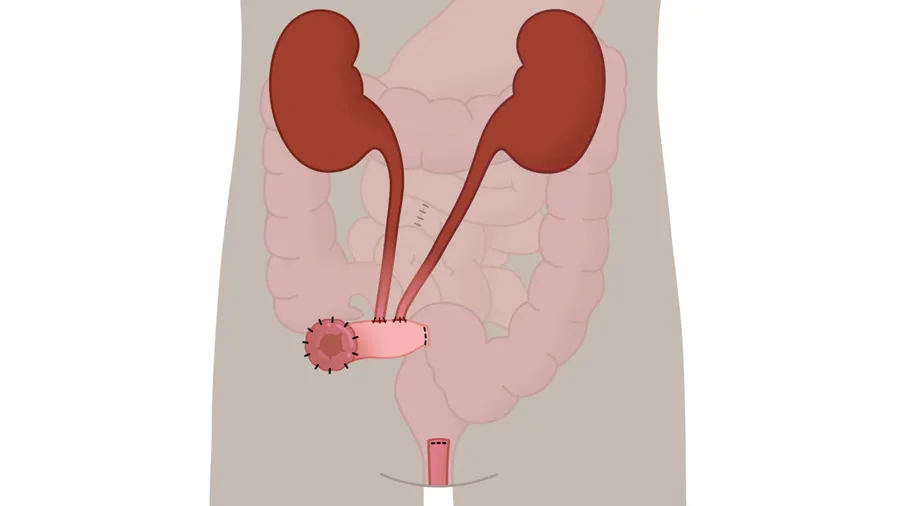
During the most commonly performed urostomy surgery, called an ileal conduit, the surgeon takes a six to eight inch piece of the small bowel (the ileum) and makes it into a conduit (or pipeline) for urine. The remainder of the small bowel is reconnected so your bowel will function as it did before surgery. The ureters (tubes that carry urine from each kidney to the bladder) are removed from the bladder and joined to the piece of ileum (small bowel).

An isolated part of the intestine is brought onto the surface of the right-hand side of your abdomen and the other end is sewn up. The ureters are detached from the bladder and reattached to the isolated section of the intestine. Because this section of the intestine is too small to function as a reservoir, and there is no muscle or valve to control urination, you will need a urostomy pouch to collect the urine.

Urostomy surgery is a major operation, so it is normal to feel weak for a while. You may experience pain from the surgery, and medication can be prescribed by the doctor to help you feel more comfortable.

Urine is made by the kidneys and travels through two tubes (ureters) to the bladder. The urine is stored here before passing out of the body through the urethra. If a problem occurs within the bladder, this process may be changed, leading to the bladder being removed from the body and having to find a new system for urine to be passed from the body - this is a when a urostomy is formed.

After surgery, your stoma may be quite swollen to begin with, but will reduce in size over time – usually after six to eight weeks.

No sensation, no pain

A stoma is red in colour. This is because it is a mucous membrane, just like the mucous membrane inside your mouth. There is no sensation in the stoma, so it is not at all painful to touch. The stoma can bleed a little when being cleaned, especially in the beginning, but this is quite normal, and should stop shortly afterwards.

Stomas come in all different shapes and sizes - some are quite short and sit flat against the belly, while some protrude a little. Some people will have more than one stoma, depending on their condition.

Urostomy bag types

Urostomy bags come with a tap and urine bag to wear discreetly on your body.

There are many different types of bag available, and your specialist stoma nurse will be able to help you choose the most appropriate one. You may want to move away from the clear bag fitted immediately after your operation to an opaque version that comes in smaller sizes.

Also, you may choose to use a night drainage bag when you get home. 

There are two main types of systems: 

One-piece system 


This consists of a collection bag with an integrated adhesive baseplate, which firmly fits around your stoma. 

Two-piece system 


In the two-piece system, the collection bag is separate from the adhesive baseplate, and the two halves are securely clipped or sealed together. This means that you don’t have to remove the adhesive plate from around the stoma every time you change the bag.

Related articles

Before stoma surgery

Surgery can feel like stepping into the unknown, but how understanding it now can make everything feel a little less overwhelming later. This guide helps you make sense of what’s ahead.

Read about how to prepare for stoma surgery

After stoma surgery

The first months after surgery are key to building confidence and independence. This guide walks you through essential self-care, from protecting your skin to adjusting daily routines.

Read about what happens after stoma surgery

Overcoming skin irritation around your stoma

Redness, irritation, or discomfort around a stoma is often linked to leakage or issues with how the device fits. This article explains common causes, what to check during changes, and when to seek help.

Read about skin irritation around your stoma